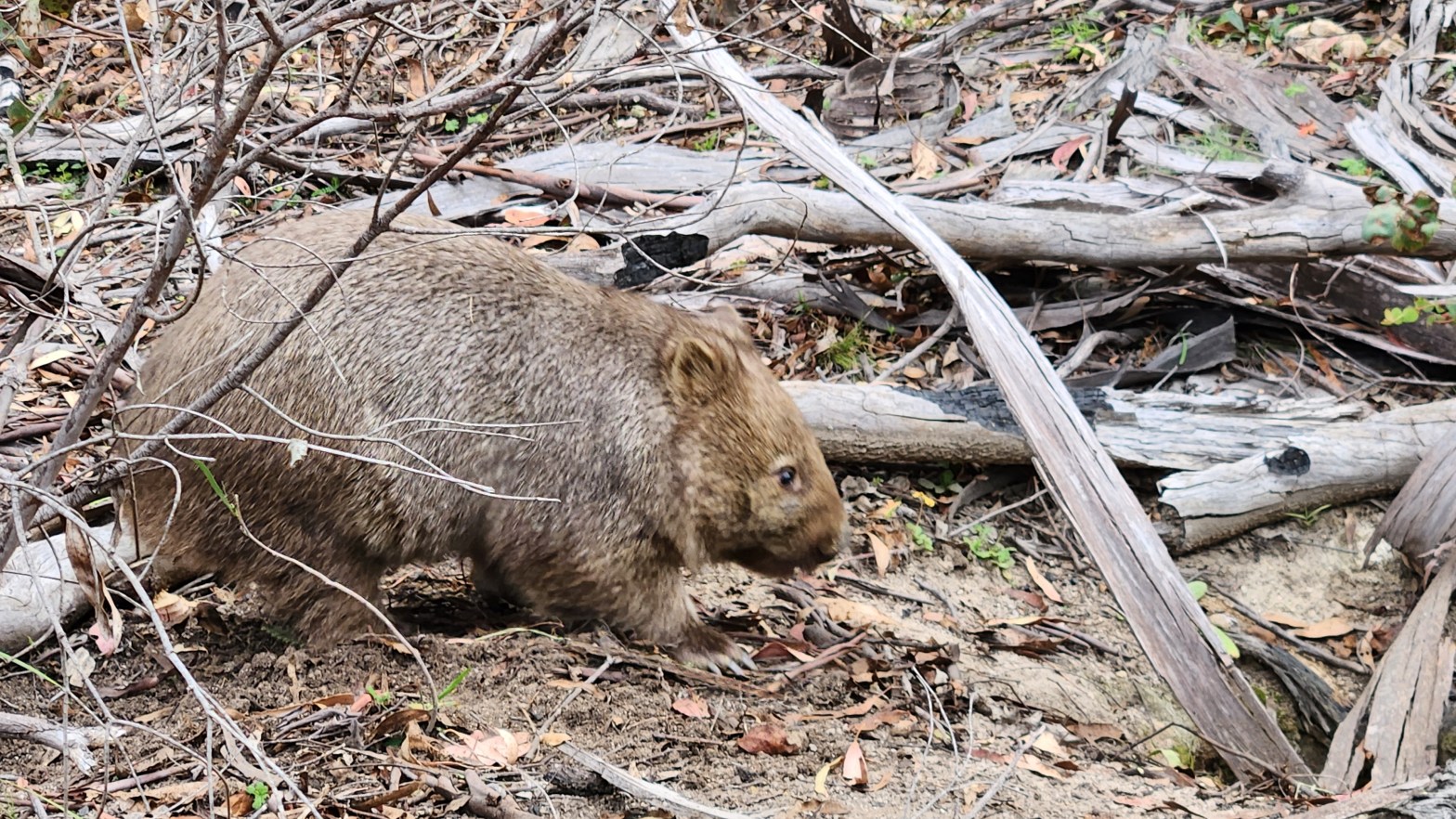
All too often, wombats are killed on the road and their joeys left alive. For the lucky ones, they are rescued and put in the hands of a carer. When you see a dead wombat at the side of the road with a big coloured X on it’s body, it means someone has checked the animal for any young.
Not all joeys that survive are found straight away. Those that are old enough may wander from the site their mother was killed. This is what happened to Clark, found wandering at the side of the road, covered in ticks and fleas, severely malnourished. He only weighed 2.5kgs when he was found, but after much care and attention he soon put on weight. He was buddied up with another young wombat whose mother had also been killed. Wombats thrive best when they have another wombat of a similar age or weight to play with. At one stage, Clark put on 3kgs in a month, a sure sign of recovery.
He continued to grow over the next 9 months but sadly his buddy, a female, wasn’t so fortunate. She suffered from a series of infections and eventually died. Clark was heartbroken. Anyone who thinks animals don’t feel emotions have never seen a wombat lose its buddy. They even shed tears as well as scream, go off their food and become lethargic. Poor Clark had first lost his mother, now his best friend. Fortunately, Clark’s carers understood his needs and did their best to comfort him, but Clark went too far the other way and decided he was a human!

As I have a large wombatorium, with natural trees, logs, and burrows, Clark came to me to learn to be a wombat before he was released into the wild. By now he weighed 18kgs and so was almost ready to be released. He quickly found a burrow he liked and learned to forage the native grasses in the enclosure. Very soon he was scratching at the fences, looking for a way to escape. Using trailcams, we could also see where other wombats, presumably those previously raised where Clark now resided, scratching at the outside of the fence to get in and meet him.
It isn’t wise to release too many wombats in one area without time for them to disperse, so it was intended that Clark would return to his carers and be released near them. However, for various reasons, this became impractical so it was agreed the carers would come to me and catch Clark. We would drive him up the back of my property, several kilometres away, and release him far from the others.
A friend and I spent time looking for a suitable burrow and checking that there were no current residents in it. With a suitable location found, it was time for Clark to become a wild wombat. His carers came out and, despite him never leaving his burrow for me, he rushed out to greet them, launching himself at them and biting. He may have thought he was playing, but wombat bites hurt! In the wild, a mother wombat would discipline a young wombat to mind its manners, but Clark hadn’t had the opportunity of this teaching.
His carer lifted him up, exclaiming how much he had grown in the month he had been with me, and slid him into the transport cage. Well padded on the back of the ute, we strapped the cage on and headed off up the steep hill to his new home.

Clark didn’t seem at all distressed about his drive and exited the cage with slow careful steps. He sniffed the burrow we had located for him then settled down to eat a sweet potato (kumara), his favourite treat. We set up a camera and a watering point, plus scattered hay for him to eat or use as bedding as he wished.
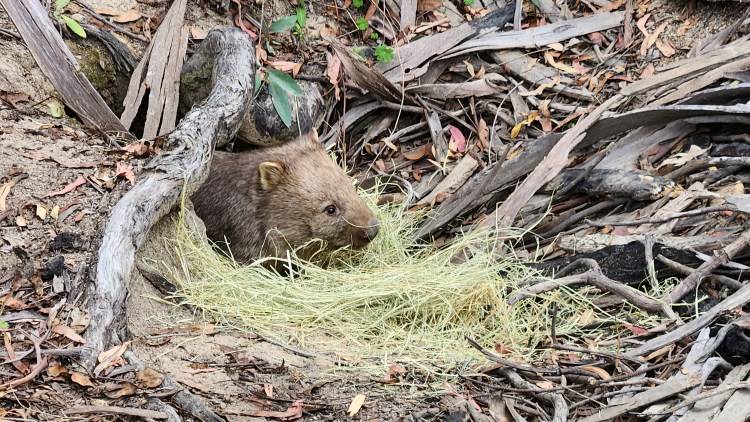
The next day, when we checked on him, it was obvious he had met one of the local wombats as he had a fresh scar on his head and was much subdued. The camera showed that he tried to settle in a different burrow from the one we had selected, but an adult wombat had obviously taught him a lesson in manners and said he wasn’t welcome in that home. Clark seemed glad to see us for the food we provided, but otherwise was uninterested in our presence. His de-humanisation had worked.

Clark is now settled into his life in the wild. We will continue to check him via camera, and will gradually stop providing supplementary feed. What a gratifying experience, to see an orphan joey grow into a strong confident adult and live the life he was intended to lead.

I’m a member of LAOKO (Snowy Mountains Wildlife Rescue). Their motto is “Rescue, Raise, Release”. Please consider supporting them to continue helping native Australian animals like Clark.
Thanks also to Humane World for Animals (formerly Humane Society International) for their generous support in building the wombatorium.
 Paula Boer